Blogs
What's New Trending

 by kkannappan@gmail.com
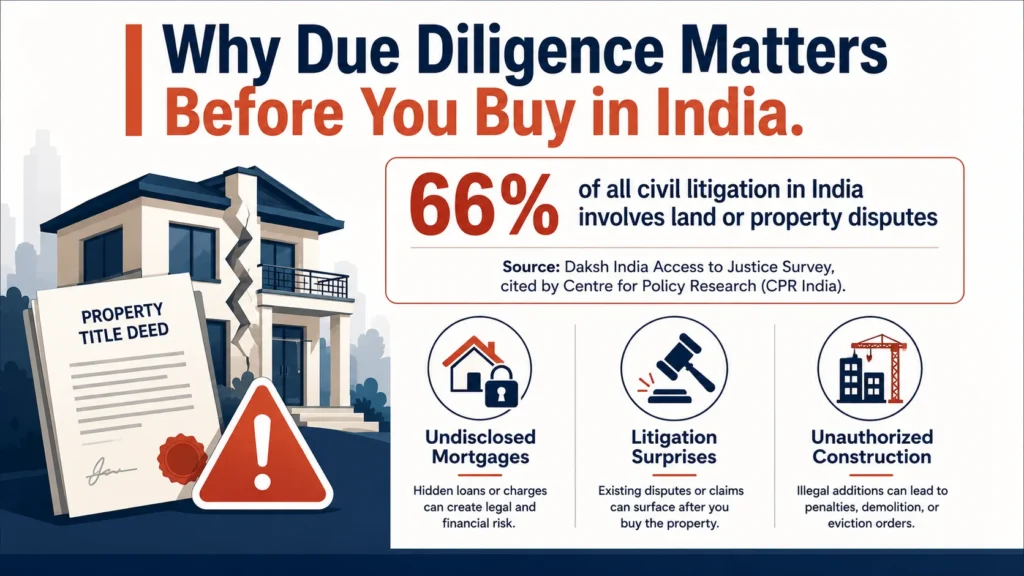
A clean-looking property can still come with a defective title, an undisclosed mortgage, or a pending court case that transfers straight to you the moment you register the sale deed. In short, the core checklist has four pillars – title verification, encumbrance certificate, zoning/approvals, and litigation check – plus a handful of supporting documents most buyers skip. Here’s what to actually ask for, in order.
In fact, due diligence means confirming, with documents and not just the seller’s word, that the property has a clean legal title, no hidden debts against it, the right approvals to be built and occupied, and no ongoing disputes. In practice this is four core checks – title, encumbrance, zoning/approvals, litigation – plus tax and possession verification. As a result, skipping any one of these is how buyers end up owning someone else’s legal problem.
Above all, treat this as a sequence, not a checklist you tick off in any order. Title and encumbrance come first, because if either fails, nothing else matters.
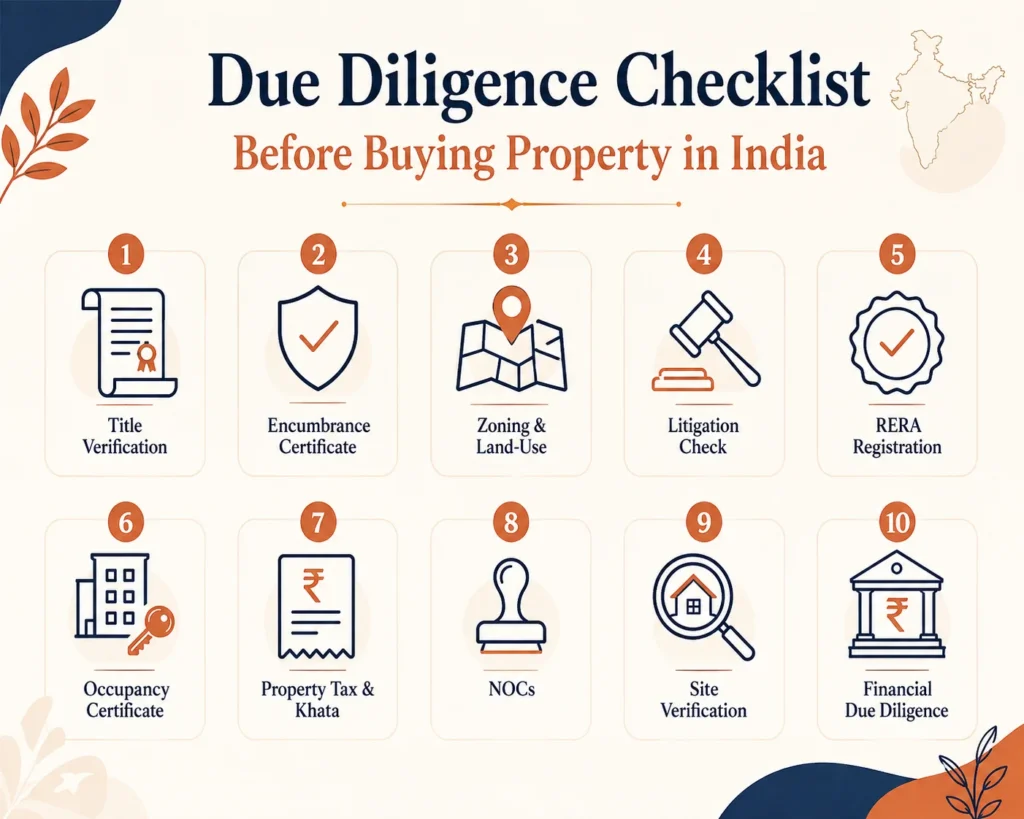
Of course, a clean title means the seller has full, undisputed legal ownership and the right to sell – proven by an unbroken chain of ownership documents, not just the current sale deed. You’re tracing the property’s ownership history backward through the mother deed and every sale, gift, or inheritance transfer since, checking each one is properly registered and internally consistent.
Lenders and lawyers commonly trace title back 12–13 years at minimum, though many recommend 30 years for full comfort – the exact requirement varies by state and by your bank if you’re taking a loan, so confirm the applicable period with your lawyer or lender before relying on a shorter search. Who does this: a property lawyer is the standard route for a formal title search report, which you’ll also need if you’re financing the purchase. Some buyers use dedicated title-search agencies, and it’s technically possible to pull documents yourself from the sub-registrar’s office, but reading them correctly – spotting a broken chain or a defective transfer – is not a DIY skill for most people.
An Encumbrance Certificate confirms whether a property is free of registered mortgages, loans, or legal liabilities for a given period – it’s the single fastest way to check if someone else has a financial claim on the property you’re about to buy. Similarly, always pull it for as long a period as the title search covers, not just the last year or two.
You’ll get one of two results: Form 15, which lists every registered transaction (mortgages, sales, gifts) against the property in that period, or Form 16, a “nil encumbrance” certificate confirming no such transactions were found. Indeed, a Form 16 covering a short window is far less reassuring than a Form 15 you can actually read through.
Most states now let you generate an EC online through the state sub-registrar or revenue department portal – for example Karnataka’s Kaveri Online Services or Tamil Nadu’s TNREGINET. The process, portal name, and fees vary by state, so confirm the correct site for your property’s location rather than assuming it’s the same everywhere.
As a result, zoning verification confirms the land is legally designated for the use you’re buying it for – residential, commercial, or otherwise – and that any construction on it matches what the local development authority actually approved. Buying a “residential” property sitting on land still classified agricultural in municipal records is a real and common trap.
If the land was originally agricultural, check for a Non-Agricultural (NA) conversion certificate – without it, any residential structure on that land can technically be treated as unauthorized, regardless of what the builder’s brochure says.
Also confirm the building complies with the sanctioned FSI/FAR (Floor Space Index / Floor Area Ratio) for that plot. A building noticeably larger or taller than what the approved plan allows isn’t a bonus – it’s usually a sign of unauthorized construction that can complicate resale, loans, and even lead to demolition orders in extreme cases.
A litigation check confirms the property itself – and ideally the seller – isn’t tied up in an ongoing legal dispute that could freeze the sale or transfer the problem to you after registration. This means checking civil court records, RERA complaint filings (for builder projects), and consumer forum cases connected to the property or the seller/developer.
There’s an important distinction here: litigation on the specific property (a boundary dispute, an inheritance challenge, a bank recovery case) is a direct red flag for that transaction. Litigation involving the seller or builder generally – say, other unrelated project delays or complaints – is a broader trust signal worth knowing about, but doesn’t necessarily kill this specific deal. Of course, your lawyer should be able to tell you which kind you’re looking at.
For any project still under construction or recently completed, a valid RERA registration number confirms the developer has registered the project with the state regulator and disclosed basic details – approved plans, timelines, and escrow account information – but it does not by itself guarantee construction quality or on-time delivery.
Generally, every state runs its own RERA portal where you can search a project by name, developer, or registration number and cross-check the promised delivery date, sanctioned plans, and any complaints filed against the project. Treat “no RERA number” on an under-construction project as an immediate stop, not a minor gap – it’s one of the most common red flags in Indian real estate, and it’s illegal for most residential and commercial projects above a certain size to sell without one.
A sanctioned building plan is the local authority’s pre-approval for what can legally be built on the plot; a Completion Certificate (CC) confirms the building was actually constructed as approved; and an Occupancy Certificate (OC) confirms it’s certified safe and legal to move into. All three are different documents, and a “ready to move in” listing without an OC is not just a paperwork gap – it can affect your ability to get utility connections, a home loan, and resale value later.
If a builder tells you the OC is “in process” and offers possession anyway, get that timeline and the risk in writing, and understand you may be moving into a technically unauthorized occupancy until it comes through.
Before you buy, confirm there are no pending property tax dues, electricity, water, or maintenance charges that could transfer to you as the new owner. Ask the seller for the latest property tax receipt and get a written no-dues confirmation from the housing society or municipal body where applicable. Also verify the khata (or the equivalent municipal ownership record in your state – names vary) reflects the current or outgoing owner correctly. A property that’s fully paid for but never properly mutated in municipal records can create real friction when you try to register the sale or pay taxes under your own name later.
Depending on the property type, you may need one or more No-Objection Certificates before the sale is clean: a society/association NOC for apartments, a fire safety NOC for larger residential or commercial buildings, and – for certain locations – environmental clearance or airport-height-restriction clearance if the property sits near a flight path or protected zone.
Not every NOC applies to every purchase. A single flat in an established society mainly needs the society NOC; a large project or a plot in a specially regulated zone needs more. Your lawyer should tell you which NOCs are actually relevant to your specific purchase rather than chasing every one on a generic list.
Paper checks confirm legal ownership; a physical site visit confirms the property on paper is the property on the ground. Walk the boundaries against the measurements in the sale deed, check for any encroachment, and confirm the seller is actually in a position to hand over vacant possession – not atenant -occupied unit or one under a family dispute that hasn’t shown up in the title search yet.
Beyond the encumbrance certificate, get an independent bank valuation of the property – it’s a useful sanity check on whether the asking price is reasonable, and most lenders will require one anyway if you’re taking a home loan. This step also often surfaces an existing mortgage or lien the seller hasn’t voluntarily disclosed, which is exactly what the EC is meant to catch – treat these two checks as backing each other up, not as redundant.
If you’re buying from outside India, every check above still applies – you just can’t walk the site or sit across the table from the sub-registrar yourself. The practical fix is a local property lawyer who can run the title search, pull the EC, and physically verify the site on your behalf, combined with a Power of Attorney (PoA) if you need someone to sign documents or complete registration in your absence.
A quick but important flag: NRIs cannot buy agricultural land, farmhouses, or plantation property in India under FEMA rules, regardless of how the listing is worded. This is one of the most common trip-ups for NRI buyers, and it’s worth confirming a property’s actual land classification – not just its marketed use – before you get attached to it. Residential and commercial property purchases don’t need RBI approval, but agricultural-category land is a hard no unless inherited or specifically permitted.
No RERA number on an under-construction project
Seller or agent pressuring you to skip the title search or “just trust the paperwork”
Price significantly below comparable properties in the same area with no clear explanation
Missing or unclear chain of ownership documents
Property tax or society dues the seller can’t produce receipts for
No Occupancy Certificate on a “ready to move in” property
Reluctance to share original documents, only photocopies or scans
A thorough title, encumbrance, and litigation check typically takes anywhere from a few days to a few weeks, depending on how far back the title needs to be traced and how quickly the sub-registrar’s office and RERA portal respond. Building in buffer time before your target registration date is worth it.
You can pull some documents yourself, like an EC or a RERA search, but reading a title chain correctly and spotting a defective transfer is specialized work. Most lenders will also require a lawyer’s title search report before approving a home loan, so it’s rarely optional in practice.
An EC shows registered financial transactions (mortgages, liens, prior sales) against a property for a given period. A title search is broader – it traces the full ownership history to confirm the seller actually has the legal right to sell. You need both; neither substitutes for the other.
No. A RERA number confirms the project is registered and certain disclosures were made, but it doesn’t guarantee construction quality, timely delivery, or that the builder has no other complaints. Check the project’s specific RERA filing for delivery dates and any complaints, not just whether a number exists.
Treat this as a serious red flag, not a negotiable point. A seller with a genuinely clean title has no reason to withhold originals from a serious buyer’s lawyer for verification.
The core checklist is the same, but NRIs typically need a local lawyer to handle checks in person, may need a Power of Attorney for signing
and registration, and must confirm the property isn’t agricultural land, a farmhouse, or plantation property – categories NRIs are restricted from purchasing under FEMA.
This article is general information, not legal, tax, or financial advice. Property laws, RERA rules, and state-specific processes change and vary by location – confirm current requirements with a qualified property lawyer, your bank, and the relevant state RERA authority before making a purchase decision.
[RERA state portal directory – check your project on the relevant state’s official site]
Income Tax Department of India – for property tax and TDS-related queries
FEMA/RBI notifications on NRI property purchase restrictions
Buying in a specific city and want a shortlist of RERA-registered projects that clear this checklist? Get in touch and we’ll help you narrow it down.
5 Comments