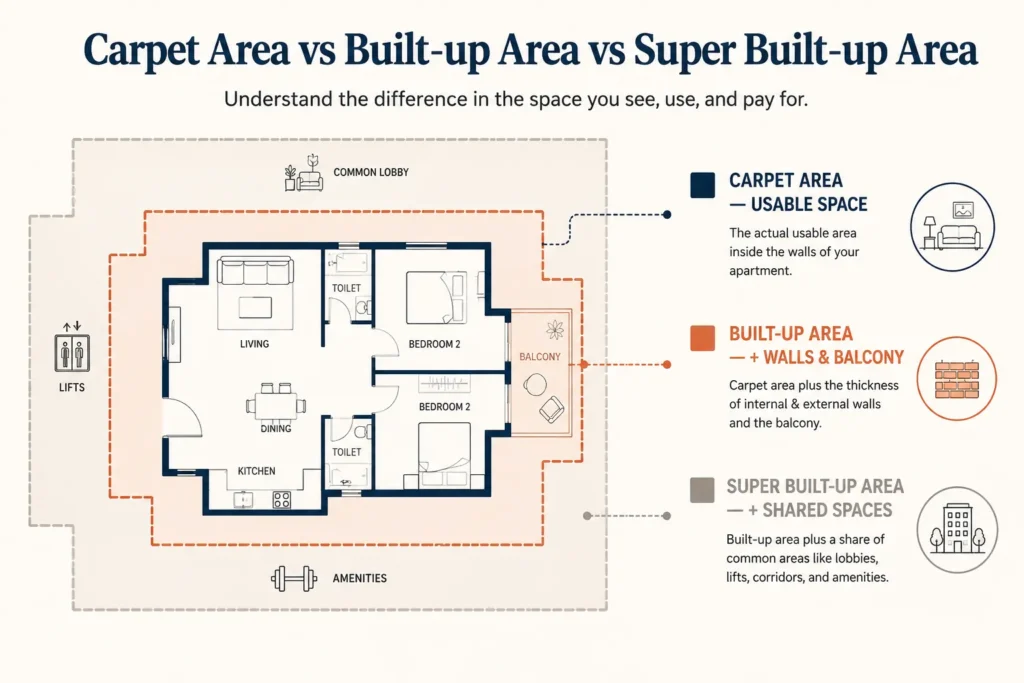
Carpet area is the actual usable floor space inside your apartment’s walls – the only figure RERA requires builders to price on. Built-up area adds wall thickness and balconies, typically 10–15% more than carpet area. In contrast, super built-up area adds your share of lobbies, lifts, and amenities on top of that, commonly 20–40% more than carpet area. For example, a “1,300 sq ft” flat quoted on super built-up terms might hand you only 900–950 sq ft you can actually furnish.
The Three Terms, Defined Properly
Carpet area is the net usable floor space within the inner faces of your apartment’s walls – the area you could theoretically lay carpet across, room by room. Under RERA Section 2(k), this is a legally defined term, and it’s the only area figure the Act requires developers to use when quoting a price per square foot.
Built-up area adds the thickness of your internal and external walls, plus any balcony or utility/service duct area that falls within your unit’s boundary, to the carpet area. It’s typically 10–15% larger than carpet area and represents the physical footprint of your apartment if you traced a line around its outer walls.
Super built-up area (sometimes called “saleable area”) takes built-up area and adds your proportionate share of the building’s common areas — lobbies, staircases, lift wells, clubhouse, gym, swimming pool, security cabin, and landscaped areas. This is the figure builders most often use in marketing and pricing, and it’s where the real gap between what you pay for and what you actually live in opens up.
The Loading Factor: Where the Gap Comes From
Indeed, the extra percentage added on top of carpet area to reach super built-up area is called the loading factor. It’s calculated as:
Loading Factor = (Super Built-up Area − Carpet Area) ÷ Carpet Area
So a 1,000 sq ft carpet area apartment sold as 1,300 sq ft super built-up has a loading factor of 30% — meaning 30% of what you’re paying for is shared common space, not space inside your own walls.
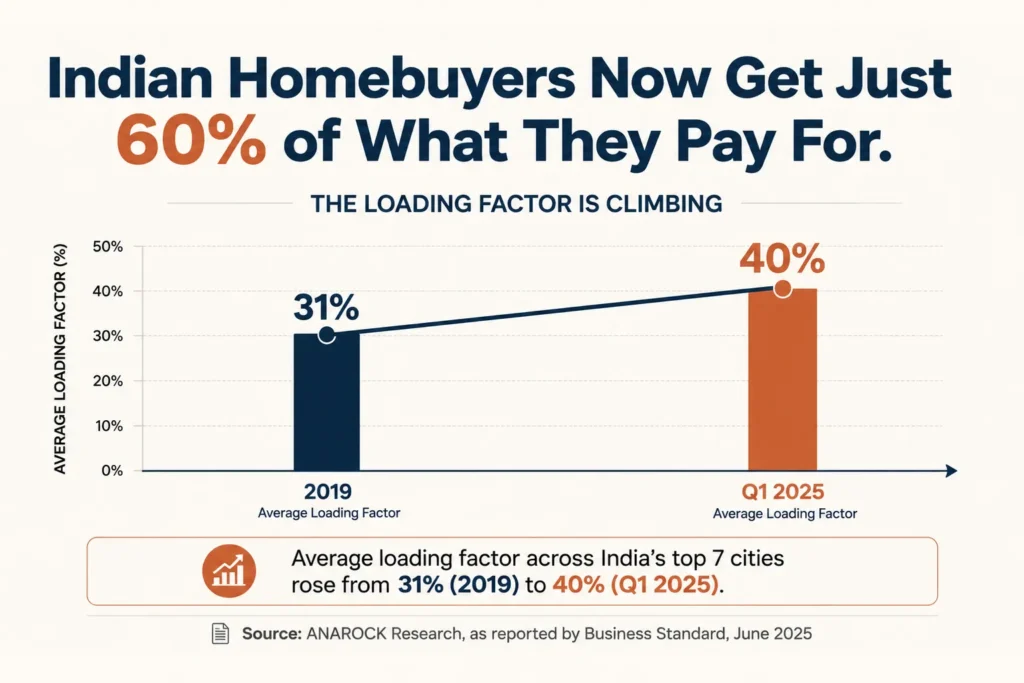
According to property consultancy ANAROCK, the average loading factor across major Indian cities rose from 31% in 2019 to 40% in the January–March quarter of 2025 — meaning the typical homebuyer in India’s top seven cities now gets roughly 60% of their purchased area as actual livable space, with the remaining 40% going toward lobbies, staircases, clubhouses, and other shared amenities. Indeed, Bengaluru saw the steepest rise over that period, moving from around 30% to roughly 41% loading. There’s no legal cap on how high a builder can set this figure — RERA requires disclosure of carpet area, but doesn’t limit how much a builder can add on top of it.
Worked Example: What a "1,300 sq ft" Listing Really Gets You
Say a builder advertises a 2 BHK at ₹ 65 lakh, quoted at 1,300 sq ft super built-up, priced at roughly ₹ 5,000 per sq ft on that basis. If the project’s loading factor is 30%, the actual carpet area works out to about 1,000 sq ft. Your real price per sq ft of usable space isn’t ₹ 5,000 — it’s closer to ₹ 6,500. A neighboring project quoting the same ₹ 65 lakh at a 1,150 sq ft carpet area (with a lower, say 15%, loading factor) is actually giving you more livable space for the same money, even though its headline “sq ft” number looks smaller.
This is exactly why comparing projects purely on quoted super built-up price-per-sq-ft can mislead you — always convert to a carpet-area basis before comparing two properties directly.
How to Find the Real Carpet Area Before You Buy
Check the project’s RERA registration filing. For any RERA-registered project, the carpet area for eachunit type is disclosed in the public registration documents on the relevant state RERA portal — this is the most reliable source, more so than a builder’s brochure or a broker’s listing.
Above all, ask the builder directly for the loading factor, not just the carpet area in isolation. Of course, a builder who hesitates to give you a straight percentage is worth being cautious about.
Do the math yourself using the formula above once you have both figures, rather than trusting a verbally quoted percentage.
For a ready or under-construction unit you can access, measure it. Generally, a laser distance meter is inexpensive and lets you verify the actual carpet area against what’s on paper.
Similarly, compare loading factors across similar projects in the same micro-market, not just the raw price-per-sq-ft. In fact, two projects at the same super built-up price can differ substantially in what you actually get to live in.
Comparison: The Three Area Types at a Glance
|
Carpet Area |
Built-up Area |
Super Built-up Area |
|
What it includes
|
Usable floor space inside your walls
|
Carpet area + wall thickness + balcony/utility area
|
Built-up area + share of lobbies, lifts, clubhouse, amenities
|
|
Typical size vs. carpet area
|
Baseline (100%)
|
~10–15% more
|
~20–40% more (varies widely by project)
|
|
RERA pricing requirement
|
Must be disclosed and used for pricing
|
Not the RERA pricing basis
|
Not the RERA pricing basis — but commonly used in marketing
|
|
Best used for
|
Comparing real usable space and true price-per-sq-ft across projects
|
Understanding your unit’s physical footprint
|
Understanding your total cost, including your amenity-cost share
|
FAQ SESSION
This article is general information, not legal or financial advice. Loading factors, RERA disclosure requirements, and terminology can vary by state and project — confirm the exact carpet area and loading factor for any specific property directly against its RERA registration filing before making a purchase decision.
Sources for further reading:
Real Estate (Regulation and Development) Act, 2016 — Section 2(k), definition of carpet area Your state’s official RERA portal, for the specific project’s registered carpet area ANAROCK Research — industry loading-factor data, as reported by Business Standard (June 2025)
Not sure whether a project you’re considering is quoting you a fair loading factor? Send us the project name and we’ll help you pull the real carpet area from its RERA filing.


1 Comment