Blogs
What's New Trending


 by kkannappan@gmail.com
In fact, a valid RERA registration number confirms a project is legally registered with the state regulator and that the developer has disclosed basic project details – approved plans, timelines, and escrow account information. It does not confirm construction quality or guarantee on-time delivery. Here’s exactly how to check a project’s RERA status yourself, in about 10 minutes, before you visit a site or pay a booking amount.
Under Section 3 of the Real Estate (Regulation and Development) Act, 2016, most residential and commercial projects – those on land exceeding 500 square meters or with more than eight apartments – must be registered with the relevant state RERA authority before the developer can advertise, market, or sell a single unit. In short, registration means the promoter has disclosed the project layout, land title status, approvals, and a committed completion timeline, and has agreed to keep at least 70% of buyer payments in a dedicated escrow account reserved for that project’s land and construction costs
What it doesn’t mean: RERA registration is not a quality certification, and it doesn’t guarantee the builder will hit the promised delivery date. It’s closer to a compliance floor – proof the developer made the legally required disclosures and is subject to RERA’s grievance and penalty mechanisms if things go wrong, not proof the project itself is a good investment.
What it doesn’t mean: RERA registration is not a quality certification, and it doesn’t guarantee the builder will hit the promised delivery date. It’s closer to a compliance floor – proof the developer made the legally required disclosures and is subject to RERA’s grievance and penalty mechanisms if things go wrong, not proof the project itself is a good investment.
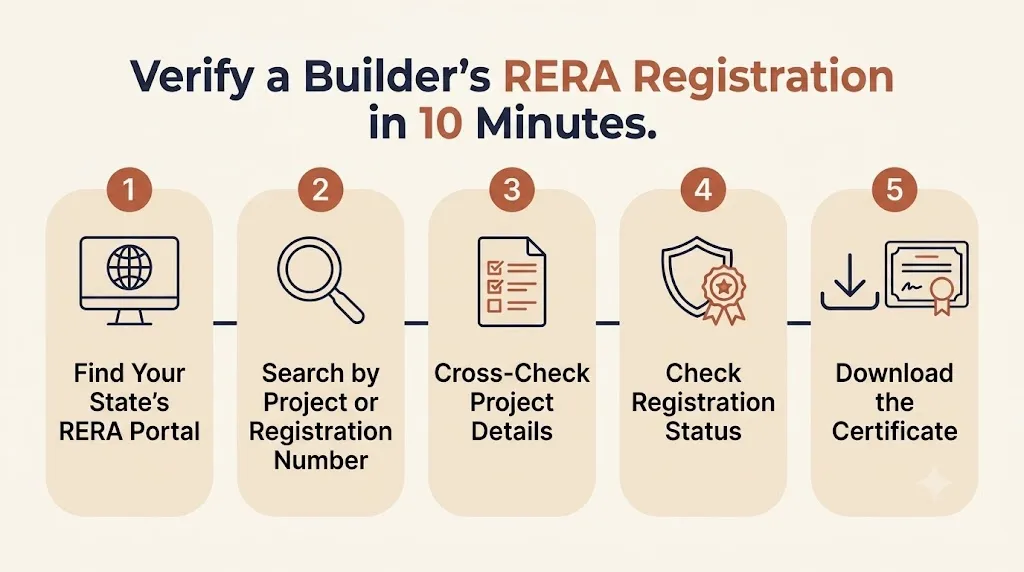
1. Identify the correct state RERA portal. Indeed, each state runs its own RERA authority and website – there’s no single national search tool. Confirm the property’s state before searching (for example, tnrera.in for Tamil Nadu, maharera.mahaonline.gov.in for Maharashtra, rera.karnataka.gov.in for Karnataka). As a result, searching the wrong state’s portal will return no results even for a genuinely registered project.
2. Navigate to the project or registration search section. Most portals have a “Registered Projects” or “Project Status” section under a Services or Search menu – exact naming and layout varies by state, so look for search options rather than a fixed menu path.
3. Search by project name, builder name, or registration number. If the builder has given you a registration number (format is state-specific, typically something like TN/29/Building/XXXX/YYYY or similar), search by that first – it’s the fastest way to pull an exact match. Otherwise, search by project name or builder/promoter name.
4. Cross-check the details against what the builder told you. Confirm the project name, promoter name, location, sanctioned unit count, and – critically – the promised completion date match what’s on the portal. Of course, a later completion date in your booking agreement than what’s registered with RERA is a violation worth raising immediately.
5. Check the registration status and validity. Registrations can show as active, expired, revoked, or void. Above all, a revoked or void status is a hard stop – don’t proceed with that project regardless of what the sales team tells you.
6. Review the latest quarterly progress update. RERA requires promoters to regularly update construction progress on the portal. If a project has gone several quarters without an update, or if the disclosed progress doesn’t match what you see on a site visit, treat that gap seriously.
7. Download the registration certificate for your records. Generally, most portals let you download an official certificate once you’ve found the project. Keep this – it’s useful documentation if a dispute arises later.
No registration number at all on an under construction project – this is close to a hard stop, since selling without registration is a direct violation of the Act.
A registration number that returns no results, or results for a different project or builder.
Registration status showing revoked or void.
A completion date in your sale agreement that’s later than the date registered with RERA – builders sometimes verbally promise later dates than what’s officially filed.
Sales pressure to book during a “pre-launch” phase before registration is complete. Pre-launch bookings on unregistered projects sit outside RERA’s protections entirely.
A builder who hesitates or delays when asked to share the registration number or certificate directly.
A clean RERA registration is necessary but not sufficient. It doesn’t replace a title search, an encumbrance certificate check, or a look at the builder’s actual delivery track record on past projects – a developer can be fully compliant on paper for a current project while having a history of delays elsewhere. RERA portals typically let you view a promoter’s other registered projects, so it’s worth checking that history alongside the specific project you’re considering.
For under-construction purchases especially, RERA verification pairs directly with the broader due-diligence process – title, encumbrance, zoning, and litigation checks all still apply and RERA registration doesn’t substitute for any of them.
| Factor | RERA-Registered Project | Unregistered / Pre-Launch Project |
|---|---|---|
| Legal protection if delayed | Right to refund or compensation under Section 18 | No RERA recourse — civil suit is the only route |
| Fund safeguarding | 70% of buyer payments held in project-specific escrow | No mandated escrow protection |
| Disclosure requirements | Mandatory quarterly progress updates, approved plans public | None — information depends entirely on what the builder chooses to share |
| Carpet-area pricing | Legally required to price on carpet area, not vague built-up figures | No standardization — comparisons across builders become unreliable |
| Recourse for defects | 5-year structural defect liability on the promoter | Governed only by whatever the sale agreement specifies |
No. Projects on land under 500 square meters or with eight or fewer apartments (across all phases) are exempt, as are projects that received a Completion Certificate before May 1, 2017. Generally, most residential and commercial developments above that threshold do need to register.
Of course, selling or advertising an unregistered project that should be registered is a violation under Section 59 of the Act, carrying penalties of up to 10% of the estimated project cost and potential imprisonment for the promoter. That’s a strong incentive for legitimate builders to register – and a strong reason to walk away from ones who haven’t.
No. It gives you legal recourse — a refund or compensation claim — if the builder misses the registered completion date, but it doesn’t prevent delays from happening. Check the promoter’s track record on other registered projects for a better sense of actual delivery reliability.
Only after you’ve independently verified it on the official state RERA portal. Don’t rely on a number quoted in marketing material or a thirdparty listing site — search it yourself directly.
Check the Completion Certificate date first. If it predates May 1, 2017, the project is legitimately exempt. If it’s more recent and still unregistered, treat that as a serious question to raise with the builder before proceeding.
This article is general information, not legal advice. RERA rules, registration thresholds, and portal processes can vary by state and change over time — confirm current requirements directly on your state’s official RERA portal, and consult a property lawyer for guidance specific to your purchase.
Real Estate (Regulation and Development) Act, 2016 — Sections 3, 4, 18, and 59 Your state’s official RERA portal (e.g., rera.tn.gov.in, maharera.mahaonline.gov.in, rera.karnataka.gov.in) for live project search and verification
Want us to run this check on a specific project you’re shortlisting? Send us the project name and state, and we’ll walk you through what the portal shows.
2 Comments