-
by kkannappan@gmail.com
- September 1, 2026
- Real-estate
- (0)
- 08 Mins
Real Estate 101: What It Is, Why People Invest In It, and What to Watch Out For
A simple starting point before you make any property decision.

Key Takeaways
- Indeed, real estate is the world’s largest asset class — worth an estimated $393 trillion, more than global stocks, bonds, and gold combined.
- It’s one of the few investments that can offer both appreciation and income at the same time.
- It comes with real trade-offs: illiquidity, high entry cost, and ongoing
management — this isn’t a “set and forget” asset. - In short, whether it’s right for you depends on your time horizon, liquidity needs, and appetite for hands-on management.
Here’s a fact that surprises most people: real estate is the single largest asset class on Earth. In fact, all the residential, commercial, and agricultural property in the world put together is worth roughly $393 trillion – more than the combined value of every stock, every bond, and every ounce of gold ever mined. In fact, all the gold humans have ever dug out of the ground, in all of history, adds up to just 5% of what real estate is worth. (Savills, 2025)
So before we get into strategy, developers, or specific markets — let’s slow down and answer the basics. What actually is real estate as an investment, why do people put their money into it, and what should you honestly know before you do the same?
Real Estate 101: What Is Real Estate, Exactly?
(New to some of these terms? Check the glossary box below.)
In the simplest terms, real estate is land and anything permanently attached to it – buildings, homes, warehouses, shops, even the crops or resources on agricultural land.
It usually gets grouped into four broad categories:
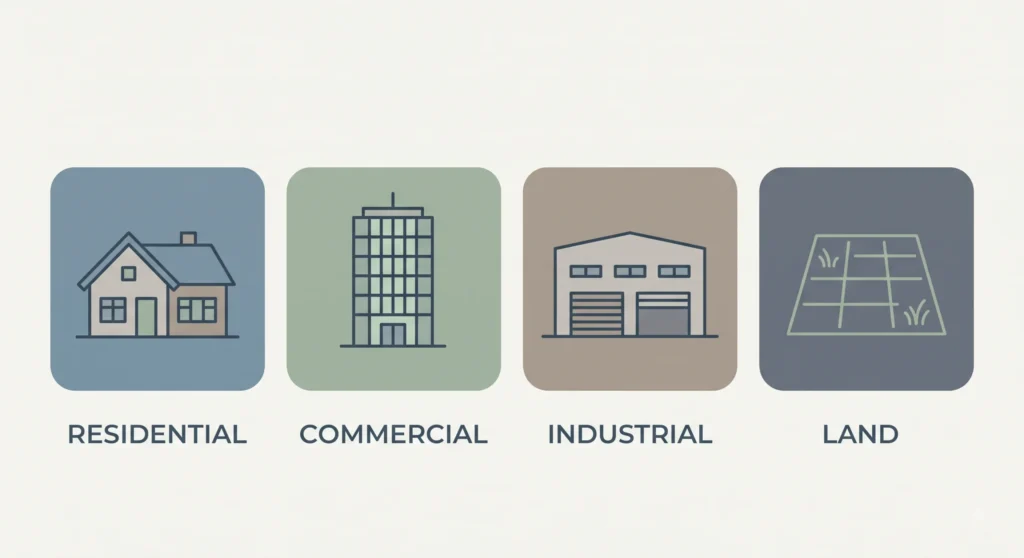
- Residential — homes, apartments, villas — anywhere people live
- Commercial — offices, retail shops, malls — spaces used for business
- Industrial — warehouses, factories, logistics parks
- Land — undeveloped plots, agricultural land, land banked for future use
Quick question: which of these four do you think makes up the biggest share of the global market by value? If you guessed residential, you’re right — homes make up roughly a third of total real estate value worldwide, more than any other category.
Real Estate 101: Why Do People Actually Invest In It?
Of course, real estate has been a wealth-building tool for centuries, and it’s not by accident. Here’s what draws people in:
- It’s a tangible, understandable asset Unlike a stock certificate or a crypto wallet, you can see it, touch it, walk through it. For a lot of first-time investors, that alone makes it feel more trustworthy than instruments they can’t physically point to.
- It can generate two kinds of returns at once Most investments give you either growth (like stocks) or income (like bonds). Real estate can give you both — the property’s value can appreciate over time, while it earns you rental income along the way. Few asset classes let you collect a “salary” from the same asset that’s also quietly growing in value.
- It’s a natural hedge against inflation As prices rise across the economy, property values and rents typically rise too. That’s part of why real estate has historically held its purchasing power better than cash sitting idle in a savings account.
- You can use leverage Banks will happily lend you 70–80% of a property’s value, something they won’t usually do for stocks. As a result, you can control a much larger asset with a smaller amount of your own money – which can amplify your returns (though it cuts both ways, as we’ll get to).
- It comes with tax advantages in many countries Depending on where you invest, you may get deductions on home loan interest, depreciation benefits on commercial property, or exemptions on long-term capital gains – real estate tax codes are often more forgiving than those for other asset classes.
- It’s the investment most people already trust A FICCI-Anarock survey found that 59% of respondents across 14 Indian cities picked real estate as their top investment choice – ahead of gold, fixed deposits, and equities. (IBEF, Real Estate India) That’s not a coincidence; it reflects generations of cultural comfort with property as “real” wealth.
A quick example: meet Rahul
To make this less abstract, let’s walk through a simple hypothetical.
Rahul is a 34-year-old NRI based in Bengaluru, working in tech. For example, he has ₹25 lakh in savings sitting in a fixed deposit earning around 6.5% a year. He’s weighing whether to instead put that money toward a down payment on a 1-BHK apartment worth ₹80 lakh, taking a loan for the rest.
If the apartment appreciates at even a modest 6% a year and earns him ₹18,000/month in rent (a ~2.7% rental yield, typical for many Indian metros), his combined annual return – appreciation plus rental income – could meaningfully outpace his fixed deposit, even after accounting for loan interest and maintenance costs. But unlike his fixed deposit, Rahul can’t access that money quickly if there’s an emergency, and he’s now responsible for tenants, repairs, and property tax. That trade-off-better long-term return potential in exchange for liquidity and effort – is the real estate decision in a nutshell.
(This is a simplified illustrative example, not financial advice or a guaranteed return projection.)
The Pros — laid out plainly
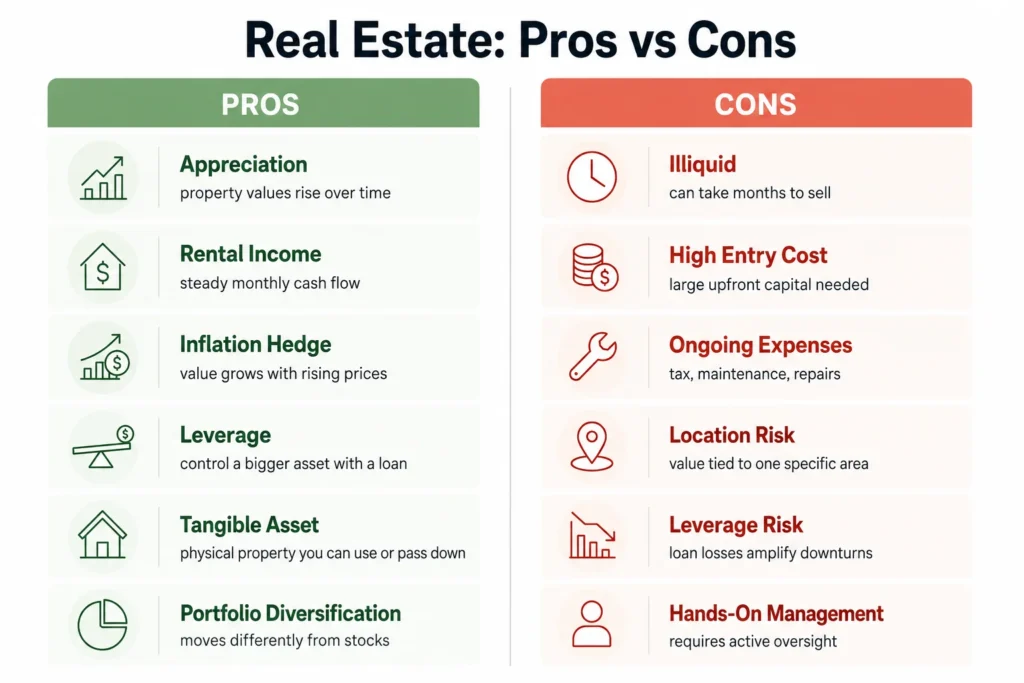
| Advantage | Why it matters |
|---|---|
| Appreciation potential | Property values tend to rise over the long term, especially in growing cities. |
| Rental income | A steady, often monthly, cash flow while you hold the asset. |
| Inflation hedge | Property and rent values generally move up with inflation, not against it. |
| Leverage | Loans let you buy a bigger asset than your cash alone would allow. |
| Tangibility | A physical asset you can use, improve, or pass down. |
| Diversification | Real estate often moves differently from stock markets, smoothing out your overall portfolio. |
| Forced savings | Loan EMIs build equity over time — a bit like a disciplined savings habit you can’t easily skip. |
The Cons — because no honest guide skips these
- It’s illiquid You can sell a stock in seconds. Selling a property can take weeks or months – sometimes longer in a slow market. If you need cash quickly, real estate is not your friend.
- High entry cost Even with a loan, you typically need a meaningful chunk of capital upfront – down payment, registration charges, stamp duty, brokerage. This isn’t an asset class you can start with a few hundred rupees.
- Ongoing costs don’t stop Property tax, maintenance, repairs, society charges, insurance – owning real estate comes with a running bill, whether or not you’re earning rental income that month.
- It’s location-dependent – a lot A great property in a declining neighbourhood is still a mediocre investment. Unlike a diversified stock fund, you can’t easily “diversify” a single piece of land – its fate is tied heavily to its specific location, local infrastructure, and economic trends around it.
- Leverage cuts both ways The same loan that amplifies your gains also amplifies your losses – and you’re on the hook for EMI payments regardless of whether the property is appreciating, vacant, or losing value.
- Market cycles are real Real estate isn’t immune to downturns. Interest rate hikes, oversupply, or local economic shocks can stall price growth for years at a stretch – patience is often part of the deal, not optional.
- It takes effort to manage Tenants, repairs, legal paperwork, disputes – unless you hire a property manager (which eats into returns), real estate is a more hands-on asset than a mutual fund you can set and forget.
So - is real estate right for you?
Real estate rewards people who can do three things: commit capital for the medium-to-long term, tolerate illiquidity, and actively manage or oversee the asset (or pay someone reliable to do it for them).
If you’re looking for something you can buy and sell within days, real estate probably isn’t it. But if you’re building wealth over years – not weeks – it remains one of the few asset classes that can quietly work for you in two directions at once: growing in value, and paying you along the way.
One last fact to leave you with: since 2019, the total value of global real estate has grown by roughly 21% – tracking closely with global economic growth over the same period. (Savills,2025) It’s not a get-rich-quick asset. It’s a get-rich-slowly-and-reliably asset, for people who understand what they’re signing up for.
Real Estate 101 Glossary
- Appreciation — the increase in a property’s value over time
- Rental yield — annual rental income as a percentage of the property’s purchase price
- Leverage — using borrowed money (a loan) to increase the size of an investment
- Liquidity — how quickly an asset can be converted to cash without losing value
- EMI — Equated Monthly Installment, the fixed monthly payment on a loan
FAQ
Is real estate a good investment for beginners?
It can be, but it requires more upfront capital and hands-on involvement than most other beginner investments like mutual funds. It’s better suited to people ready for a medium-to-long-term commitment.
How much money do I need to start investing in real estate?
This varies hugely by market and property type, but expect to need enough for a down payment (often 10–20% of property value), plus registration, stamp duty, and other transaction costs.
What's the difference between rental yield and appreciation?
Rental yield is the income you earn annually from rent, expressed as a percentage of the property price. Appreciation is the increase in the property’s resale value over time. Good investments often deliver a
combination of both.
Is real estate riskier than stocks?
It carries different risks, not necessarily “more.” Real estate is less volatile day-to-day but far less liquid, and losses can be amplified by leverage (your loan).
Do I need to manage the property myself?
No – many investors hire property managers or work with agencies to handle tenants, maintenance, and paperwork, though this comes at a cost that reduces net returns.
Leave a Reply